Smoothing Up Top: The Sports Bra and Top Choices That Finish the Sleek Silhouette
The smoothing conversation stops at the waistband while the upper body has its own vocabulary — the band bulge, the underarm spillover, the back lines — and the sleek silhouette is finished up top with the same fit-and-fabric literacy. The upper-body smoothing guide.


The Problem Map
Where tops betray: the band-edge lines (the too-tight band creating the shelf bulge — the fit issue masquerading as a body issue per the fit doctrine; the band digging being sizing, not anatomy), the underarm spillover (the low-cut sides and narrow bands pushing tissue outward — the coverage geometry problem), the back topology (the strap-and-band lines under fitted tops — the racerback-versus-classic placements reading differently), the shoulder-strap dents (the thin straps under load — the width-and-padding factors from the support doctrine), and the reframe restated (the smooth line being ENGINEERING, not body correction — the body-neutral framing from the smoothing doctrine; the goal being comfort-and-confidence in the clothes you chose).

The Feature Guide
What to look for: the wide-band principle (the broader underband distributing pressure — the line softened by width; the longline bras extending the band into a smooth zone: the category’s smoothing champion per the bra doctrine), the side-coverage spec (the higher side panels containing the underarm zone — the full-coverage cuts over the barely-there for smooth-priority days), the fabric-weight factor (the substantial compressive knits over thin stretch — the same density logic from the fabric doctrine applied up top; the bonded-and-laser-cut edges that vanish under tops), the strap architecture (the wider straps and padded options — the dents prevented; the adjustability for the fit dial per the fit doctrine), the fit protocol (the band-size honesty — the band snug on the LOOSEST hook when new; the spillover meaning cup-or-coverage size, not failure; the professional-fitting case from the bra doctrine), and the top-layer choices (the double-lined tanks and thicker knits skimming over lines — the built-in-bra tops for low-impact days; the texture-and-pattern camouflage from the styling doctrine).
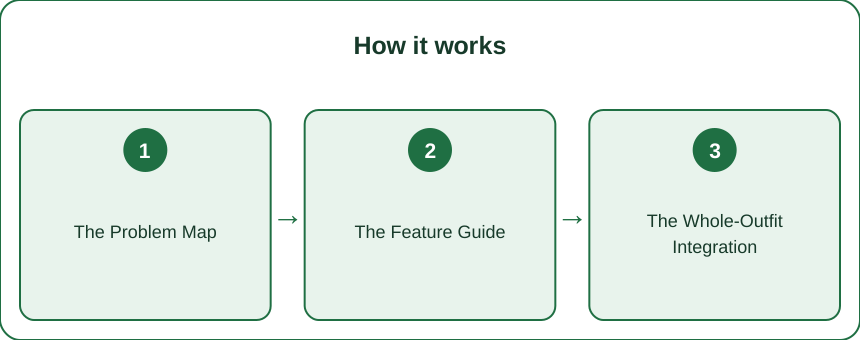
The Whole-Outfit Integration
Finishing the silhouette: the rise-and-band meeting (the high-rise bottom and longline bra creating the continuous line — the gap-and-overlap zone managed per the rise doctrine; the no-man’s-land of skin-and-band eliminated), the monochrome multiplier (the matched tones smoothing visually from the monochrome doctrine — the single-color column reading sleekest), the layering plays (the longline-bra-plus-open-layer summer formula from the layering doctrine — the fitted tank under the sheer tee), the support-versus-smooth honesty (the high-impact days needing the real support bra regardless of lines per the support doctrine — the smoothing prioritized on low-impact and styling days; the both-goals bra existing at the quality tier), the size-inclusive notes (the extended-band-and-cup ranges from the inclusive brands — the fit-first shopping per the sizing doctrine), the care reminder (the elastic life protected by the wash rules from the care doctrine — the stretched-out band being the return of every problem), and the closing frame (the upper-body smoothness being three decisions — the band wide enough, the coverage high enough, the fabric thick enough; the silhouette finished top to bottom; the mirror, meeting a continuous line). Wide bands, side coverage, substantial fabric: the top half, smoothed to match.
Upper-body lines are fit engineering: wide or longline bands distribute pressure, higher side panels contain spillover, and substantial double-lined fabrics skim where thin stretch clings. Band snug on the loosest hook, real support still wins on high-impact days, and monochrome finishes the continuous line.
Keep Reading
This article is for general informational and styling purposes only. Fit, sizing, and product availability may vary — check current details before purchasing.